Esther, Martín y Ricardo son tres funcionarios destinados en los servicios centrales de la Secretaría General de Instituciones Penitenciarias con sede en Madrid, concretamente en la Calle Alcalá, 38-40.
Esther, funcionaria del Cuerpo Superior de Técnicos de Instituciones Penitenciarias, trabaja en el Servicio de Clasificación, donde se resuelven las propuestas que formulan los distintos Establecimientos Penitenciarios.
Martín, también funcionario del Cuerpo Superior de Técnicos de Instituciones Penitenciarias, es el Jefe del Servicio de Contratación de Suministros y se encarga de la preparación y tramitación de los expedientes de contratación de ese carácter. Anteriormente, estuvo destinado en la unidad encargada de la gestión de la pena de localización permanente en Centro Penitenciario.
Ricardo, funcionario del Cuerpo de Ayudantes de Instituciones Penitenciarias es el más veterano y conocido en todas las plantas del edificio de la Secretaria General. Tras un periodo en el que se dedicó a llevar la documentación relativa a la gestión patrimonial de los inmuebles y equipamientos de la Secretaría General, ha pasado a ocuparse del seguimiento y control de las medidas de control telemático. Sin embargo, la ilusión de toda la vida de Ricardo ha sido trabajar en lo referente a las unidades de madres, pues es socio de UNICEF y está muy sensibilizado con todo lo que tenga que ver con los niños.
Al regreso de vacaciones, el titular del Ministerio del Interior, se reúne con el Director de su Gabinete. El objeto de la reunión es tratar sobre diversos asuntos en los que el Ministro ha de intervenir en fechas próximas.
El más cercano se centra en acudir a la inauguración del nuevo Centro de Inserción Social «Manuel Benítez» en Sevilla. También está previsto lanzar una campaña informativa, a través de radio y televisión, sobre los servicios que presta el Departamento, especialmente en relación con las Fuerzas y Cuerpos de Seguridad del Estado.
Por otro parte, diversos representantes del Ministerio deben participar en un Comité del Consejo de la Unión Europea y es necesaria la coordinación de actuaciones con el Ministerio de Asuntos Exteriores.
Pero existen otros asuntos que son los que realmente preocupan al Ministro: en primer lugar, la gestión de las competencias en materia de protección civil y emergencias, ya que últimamente se han producido fallos en la difusión de alertas por nevadas a los ciudadanos; en segundo lugar, la gestión financiera de ingresos y gastos y de tesorería de los créditos presupuestarios del Departamento y, en tercer lugar, la propia organización del Ministerio, que no le convence demasiado.
What do you think about…shoes?
Most of us wear shoes every day. They protect our feet from the things we do every day – walking, school, sports and so on. But for some people they are more than that. They follow shoe styles, and a good pair of fashionable shoes – trainers, sandals, or regular shoes – will not be cheap. Magaboutyou did a survey and we discovered that many of you pay a lot of money for shoes. We think it’s because they are an essential fashion item – for guys and gals! A pair of shoes can make or break your style!
Here are some of the comments from the survey
I think it’s silly the way everyone in my school wears the same shoes. We don’t have a uniform but the girls all wear the same black trainers. There is one girl in my class who wears different things – but she isn’t fashionable, in my opinion. My friends and I wear comfortable trainers and yes, maybe they are all from the same shop. But we like them!
Raffi, South Africa
I love shoes, especially trainers. They are fashionable and comfortable. You can wear them with everything – trousers, skirts, and so on. At school we did a project where we had to add something to a pair of white trainers. I wrote half my name on the left, and the other half on the right. It was such a cool project.
Anne Belle, New Caledonia.
At my school we all have to wear black or brown shoes. It’s silly because they are really unfashionable. Nobody likes them. The teachers say they are good shoes for school, but they don’t wear them! Our art teacher has a great collection of shoes and in the summer, her sandals are always so pretty. She’s really well dressed. I want to dress like her.
Kat, Turkey
Audrey Hepburn, one of Hollywood’s legends, was a talented British actress and a UNICEF ambassador. Today, she is still considered as a fashion icon and a symbol of elegance.
Audrey was born in Belgium in 1929. Her British father and Dutch mother were divorced when she was six years old. During World War II, she lived in the Netherlands with her mother. She started studying ballet at the age of five. In
1948, They moved to England where she continued her ballet studies and started working as a model and as an actress. After Audrey’s performance in the movie Roman Holiday (1953) with Gregory Peck, she became a famous international star. Some of her most popular movies are: Sabrina (1954), Breakfast at Tiffany’s (1961) and My fair Lady (1964).
Audrey married the American actor, Mel Ferrer, in 1954. They had a son, Sean, born in 1960. Divorced in 1968, Audrey remarried to an Italian psychiatrist, Andrea Dotti, and had a son, Luca, in 1970. She divorced her second husband in 1982.
The last five years of her life, she worked as a UNICEF Ambassador helping children in poor countries. She visited communities of Africa, South America and Asia. She spoke five languages: Dutch, English, French, Spanish and Italian. In 1992, at the age of sixty-three, she died of cancer at her home in Switzerland.
CLIMBING TRIP
by Samantha Davis
My dad and I have both done a bit of climbing at our local sports centre. So we decided to go on a trip together, climbing the high rocks along the coastline of a small island. Although it wasn’t far from where we live, the journey across the sea took quite a long time – but it was worth it!
As we approached the island, Dad pointed out the rocks covered in colourful plants, wild goats and bees, which were once the only signs of life on this now popular place for visitors. The island has become well-known as a climbing venue and the ferry we took across to the island was full of climbers carrying boots and backpacks.
We arrived at the island’s harbour, full of brightly-coloured houses lit by the early-morning sun. We were met by a driver in an ancient old car, arranged by the travel company we’d booked with. The driver took us to the tiny apartment, which, like the car, had seen better days, but it was comfortable and we weren’t going to spend much time there anyway.
There are lots of possible climbs up the island’s rocks, and not all of them have been discovered by climbers, but many have places clearly marked out so climbers can easily see where to put their hands and feet. All we needed were shoes, ropes and the equipment for attaching the rope to the rocks, although despite the markings on the rocks, I still had problems! Anyway, climbing is obviously not without risk, and things can still go wrong, but you’re far less likely to get into difficulties on the island.
There was a wide range of climbers, both in ability and age, so there was no need for my previous worries about being the only teenager. Away from the rocks and back in the town, there was a very sociable atmosphere in the cafes, where we compared notes on what we’d achieved that day.
One day, our climbing destination was a rough cliff, with very little to put my hands and feet on. It was amazing how quickly I learnt to attach my rope onto the rock to avoid falling as I climbed!
Then I realised the boy climbing next to me was someone I knew. We waved, smiled and moved on, although he seemed to find the rock far less of a challenge!
Once Dad and I were down at ground level again, we stopped at a beach, which was deserted. We walked along with our feet in the water and promised ourselves that it wouldn’t be the last time that we sat on that stretch of beach.
Read the text and answer the questions:
My name’s Nora. I’m married, I’ve got a daughter and I work as a receptionist at a dentist’s office. My everyday routine is always very busy.
Yesterday, I had a terrible day. I only slept two or three hours because Mary, my daughter, had a fever. I stayed home until the doctor came. I phoned my mother and she came home to stay with Mary. I usually start work at nine but yesterday I arrived at the office at half past ten.
When I finished work, I was very tired. I went to the supermarket and did the shopping. I went home walking. It was raining and I didn’t have an umbrella. I got home completely wet, I read a story to Mary and I cooked dinner. Paul, my husband, did some housework. In the evening, he watched a film on TV but I took an aspirin and went to bed. I was exhausted.
Today, Mary is going to school. She is fine but I am not well. I have a fever and a headache, the doctor is coming to see me
El interno JM se encuentra en el establecimiento penitenciario de Madrid X. JM, nacido en Leganés (Madrid) el 12 de enero de 1990, ingresó en el centro el 2 de febrero de 2014 por mandamiento de prisión del Juzgado de Instrucción nº2 de Madrid. Fue su primer ingreso en prisión al que llegó desde los calabozos policiales donde estuvo detenido desde el día anterior. El 15 de enero de 2015 fue condenado por esta causa a 3 años de prisión iniciando su cumplimiento llegando el testimonio de sentencia a los dos días. Reunida la Junta de Tratamiento en la segunda quincena de enero de 2015 realiza la propuesta de clasificación inicial y destino correspondiente. JM es clasificado en segundo grado el 23 de marzo de 2015 por resolución de la Dirección General de Ejecución Penal y Reinserción Social, siguiendo la propuesta de la Junta de Tratamiento. En la misma Junta de Tratamiento se establece el programa individualizado de tratamiento (PIT) para JM.
A continuación se presentan frases incompletas. Deberá encontrar la palabra que completa el enunciado de modo que la frase resulte verdadera y con sentido. Recuerde que únicamente hay una respuesta correcta para cada frase.
A continuación, lea el siguiente texto del recuadro y responda a las preguntas. Cada pregunta presenta varias opciones de respuesta. Una de ellas y solo una será la correcta. Debe detectar cuál es y marcar la respuesta que considere correcta.
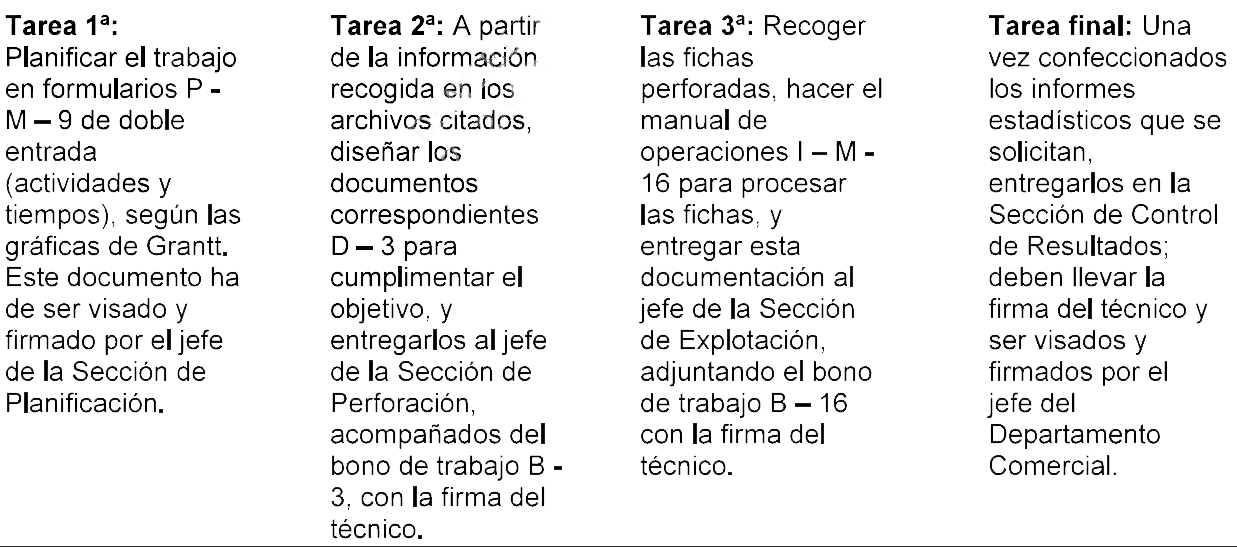
Suponga que Ud. pertenece al Departamento de Formación de una gran empresa industrial y recibe por escrito las siguientes instrucciones:
OBJETIVO: Elaborar los informes estadísticos clave EP – 13 sobre la venta de varios productos, independiente para cada uno de ellos. Estos productos son: Camisas: C – 5. Discos: M – DLP – 3. Jabón de tocador: J – 7. Menaje de cocina: MC – 5. Pasta de dientes: C – 22.
En cada uno de estos informes han de constar (con sus claves respectivas) los datos siguientes: Clave – especificación. Cl – nombre de cada cliente. Fact – total vendido a cada cliente. Ap – incremento parcial de ventas para cada cliente, con relación al año anterior. Fact – total vendido en cada producto. At – incremento total de ventas, con relación al año anterior. Ms – media de ventas por cada cliente.
Los datos precisos para este trabajo se encuentran en los archivos de: Clientes; Artículos (A – Culturales, A – Tocador y A – Vestido); Contabilidad y Salidas de Almacén, todos ellos localizados en el Departamento Comercial. Para utilizarlos, es necesaria una solicitud firmada por el jefe del Departamento de Proceso de Datos
A continuación se presentan 14 frases incompletas. Deberá encontrar la palabra que completa el enunciado de modo que la frase resulte verdadera y con sentido. Recuerde que únicamente hay una respuesta correcta para cada frase.